
Rust ESP Explained: Player, Loot and Resource ESP Features
Rust ESP is a commonly advertised feature in third-party gaming software. Discover the different ESP categories, what information they claim to display and how they differ from traditional wallhack features.
Rust is built around information.
Knowing where other players are, understanding the surrounding environment and locating useful resources can influence almost every decision during a wipe.
This is one reason Rust ESP is such a popular search term among players researching third-party gaming software.
But what exactly does ESP mean, and how do the different categories work?
Let's break down the terminology, common feature types and important limitations.
What Is Rust ESP?
ESP stands for Extra Sensory Perception.
In gaming software, the term generally describes an overlay or information display that presents additional details about objects or characters in a game environment.
Unlike ordinary visual settings, third-party ESP software may advertise information that is not normally visible to the player.
The available information depends entirely on the software.
Some products focus on players, while others advertise resources, loot, animals, vehicles or environmental objects.
Player ESP
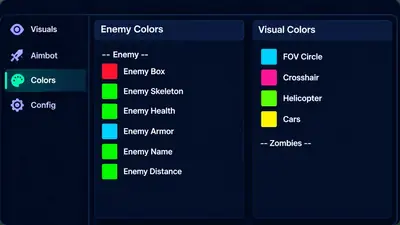
Player ESP is one of the most commonly advertised categories.
Depending on the implementation, it may display information such as:
- Player names.
- Distance indicators.
- Character boxes.
- Skeleton outlines.
- Health indicators.
- Team identification.
- Sleeping player information.
The main purpose of this category is to provide additional visual information about characters in the game world.
Different products may offer different display options, so it is important to inspect actual screenshots and documentation.
Loot ESP
Loot ESP focuses on containers and items.
Rust has numerous loot locations, including monuments, military areas, crates and other points of interest.
Third-party software may advertise visual indicators for selected containers and loot categories.
Examples include:
- Standard crates.
- Military crates.
- Elite crates.
- Supply drops.
- Barrels.
- Other collectible objects.
Not every product supports every object category.
The accuracy and availability of displayed information can also depend on game updates.
Resource ESP
Gathering resources is a major part of Rust.
Wood, stone, metal and other materials are essential for building, crafting and maintaining equipment.
Resource ESP is generally advertised as a way to display selected resource locations through an additional visual overlay.
Commonly mentioned categories include:
- Stone nodes.
- Metal ore.
- Sulfur ore.
- Trees.
- Other gathering materials.
Players researching this feature should check which resource types are actually supported instead of assuming that all products offer identical coverage.
Animal ESP
Wildlife is another important part of survival gameplay.
Animals can provide food and other useful materials, but encounters can also create unexpected threats.
Animal ESP is a category advertised by some third-party Rust software.
Depending on the implementation, it may identify animals and display additional distance or location information.
Vehicle ESP
Vehicles change how players travel across the Rust map.
Road vehicles, boats and aircraft each serve different purposes.
Some ESP products advertise vehicle indicators to provide additional information about vehicle locations.
The exact supported categories vary between software products.
What Is the Difference Between ESP and Wallhack?
The terms ESP and wallhack are often used together, but they are not always interchangeable.
ESP generally refers to displaying additional information about characters or objects.
Wallhack is a broader term associated with seeing or identifying entities through environmental obstacles.
Chams is another commonly used term. It generally describes visual highlighting that makes character models easier to distinguish.
A product may combine several of these features, while another may concentrate on only one.
What Should You Check Before Choosing an ESP Product?
Before evaluating any third-party software, consider these questions.
1. Which object categories are supported?
Check whether the product actually lists player, loot, resource, animal and vehicle information.
2. Does it support your game version?
Rust receives updates, and software compatibility can change.
3. Are the screenshots genuine?
Look for actual demonstrations rather than relying exclusively on promotional descriptions.
4. Are system requirements documented?
Windows compatibility and hardware requirements should be explained clearly.
5. Are account risks disclosed?
Third-party cheating software can lead to permanent enforcement actions. No detection-free guarantee should be treated as reliable.
Can You Improve Map Awareness Without ESP?
Absolutely.
Rust offers several legitimate ways to improve situational awareness.
You can learn monument layouts, understand common travel routes, recognize environmental sounds and practice identifying activity around important locations.
Map knowledge is particularly valuable when deciding where to build, when to rotate and how to approach resource collection.
These skills remain useful regardless of game updates or software compatibility.
Final Thoughts
Rust ESP covers several different categories of visual information.
Player ESP, loot ESP, resource ESP, animal ESP and vehicle ESP all describe different types of information that third-party software may advertise.
Understanding these distinctions makes it easier to evaluate product descriptions and avoid confusing one feature with another.
Always check actual documentation, compatibility information and the risks associated with third-party software before making a decision.
Related reading: Rust Cheats Buying Guide, Free vs Paid Rust Cheats, Rust HWID Spoofer Compatibility.